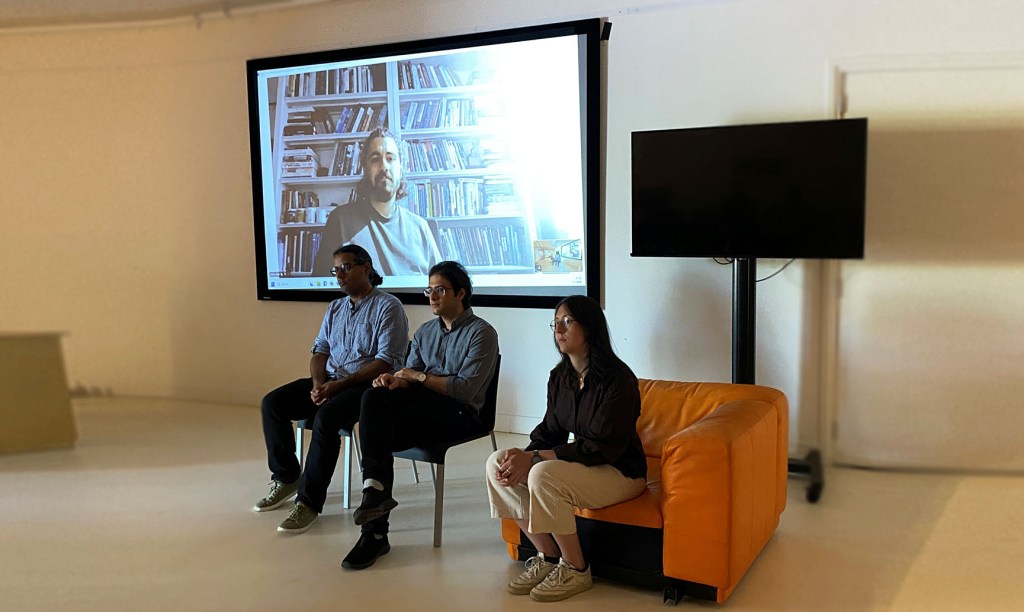
On 1st July, a small gathering among some (former) MSc/PhD students who work(ed) on/with AI and soft values in Design took place – organized by PLAIA. Several (former) students presented their work, prompted discussion with an audience from academia and practice, and debated some key questions.
After their presentations, the (former) students debated in a panel. The discussions brought together various thoughts to explore how artificial intelligence, cognitive science, and architectural design can jointly address some of the most pressing challenges facing the built environment. Building on the PhD research of Feras Alsaggaf, participants debated how AI can support an ageing population in maintaining autonomy and independence, improve our understanding of spatial cognition and navigation under cognitive decline, and strengthen the integration of architecture, cognitive science, and virtual reality as complementary research tools. Questions to Feras included several aspects of the experiments and data collection he intends to develop by using Virtual Reality. What datasets does VR enable to collect? How can VR experiences help the collection of data to train AI models? How may individuals should participate to ensure reliability of the datasets and related AI models? Casey Poot’s work prompted discussion on the use of virtual reality and electrodermal activity to investigate how façade design influences women’s perceptions of safety in urban environments, raising questions about which architectural features most strongly affect human responses and how 3D digital models can facilitate scientific analysis. Questions to Casey included reflections on how many variations of VR scenes and architectural features should be tested, how the architectural features should be selected in order to allow generalization of results, what are the limits of VR experiments when collecting data on people’s perception and reactions, how can the datasets be used to train AI models and for what. Inspired by Parsa Pouladfar’s research, the conversation examined how scarce and complex electroencephalogram (EEG) datasets could be transformed into designer-friendly insights through computational workflows that map neural responses directly onto digital building models. Questions to Parsa included clarifications on the workflow he envisions, on the limits of using current datasets, on what steps would be needed to implement the workflow he envisions and on future use he would like to target. Fatih Deniz’s work further stimulated debate on combining machine learning models to uncover meaningful correlations, causal relationships, and predictive capabilities from architectural image datasets. Questions to Faith included several considerations on the pros and cons of different Machine Learning techniques to train models, on the differences models trained with different techniques show, on the potentials of combining different ML techniques within one same design research challenge. Across all discussions, a central question emerged: what are the key directions to empower designers – how best can AI-driven, data-informed methods complement rather than replace designers’ intuition, ensuring that computational tools enhance human creativity, critical thinking, and evidence-based decision-making in architectural practice?


Leave a Reply