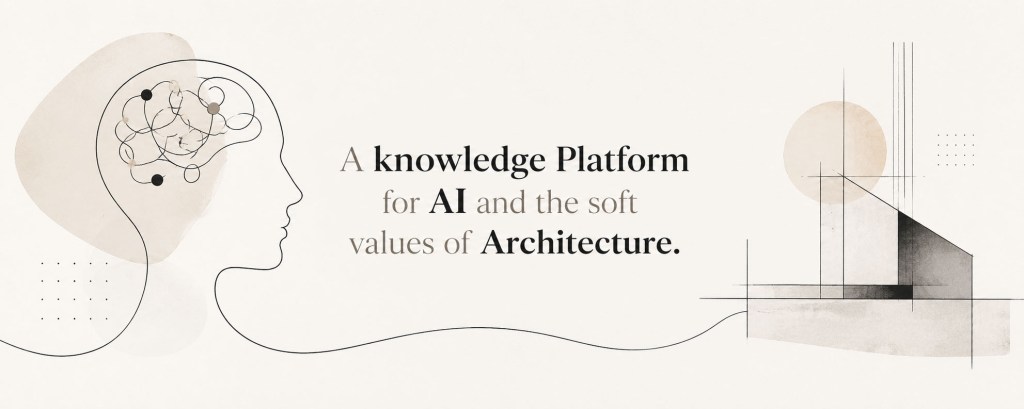
PLAIA explores how AI can empower social, cultural, and emotional values in architectural design.
Keep an eye on our activities at the page: FEATURED
The built environment has large impact on people’s well-being, health, individual and collective perception, social dynamics. Attention to this is an opportunity and an imperative. Buildings and the urban environment are under pressing urgency not only for scarcity of resources and climate change but also for soft matters. Several researches elaborate on how urban growth can increase social fragmentation, and individual stress, potentially leading to poorer mental health and social disconnection, while socioeconomic inequality worsens access to care. Many examples highlight the need to design for well-being and human experiences.
In today’s design practice, AI and computational models are mainly applied to optimise technical performance – such as energy consumption, structural performance, construction processes, or spatial efficiency. So-called ‘soft values’ – including spatial experience, identity, orientation, well-being, and social cohesion – are difficult to quantify and thus often excluded from these digital processes. AI opens new opportunities to incorporate spatial qualities in computational models. PLAIA explores how AI can support architectural design to empower the role of social, cultural, and emotional values.
—
PLAIA investigates how such soft values can still be integrated into AI-supported design. PLAIA examines new computational techniques, such as sentiment analysis, knowledge graphs, and human-centred predictive models, to enable the inclusion of subjective experiences and emotions in design workflows. The goal is not to replace designers, but to support them: AI as a form of ‘co-intelligence’ that enriches, rather than overrides, the design process.
PLAIA connects knowledge from architecture, computer science, and cognitive sciences. The project develops a shared conceptual framework, maps existing and missing datasets, and formulates methods and conditions for the responsible use of AI in architectural and urban design. Ethical, legal, and societal dimensions are explicitly part of this exploration. The results form the foundation for an interdisciplinary research platform and a long-term roadmap.
The banner image is AI generated using DALL-E

