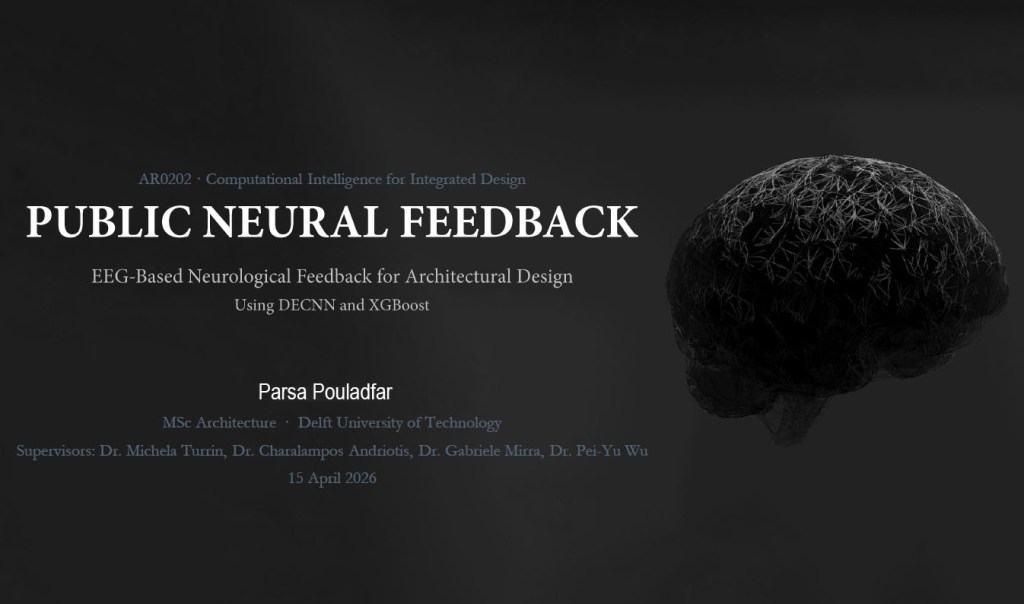
How can EEG-Based Neurological Feedback be used in architectural design? Are you Interested in Accessible EEG-Based Neurological Feedback for Architectural Design using DECNN and XGBoost?
Parsa Pouladfar has been working on this subject and will present his work. PLAIA is organizing a small gathering among some (former) MSc/PhD students who work(ed) on/with AI and soft values in Design. It takes place on 1st July afternoon – as an opportunity for students from different MSc programs and disciplines to present their work and get to know each other. It is also an opportunity for architects, researchers, experts to attend and engage in discussions around the topics the students will present.
Among other subjects relevant for AI and soft values, Parsa worked on EEG-based neurological feedback during the TU Delft MSc course AR0202 Computational Intelligence for Integrated Design. His work in this course investigated an “EEG-based neurological feedback system for architectural design. After having captured brain activity from visitors experiencing virtual architectural spaces, the proposed system cleans and classifies the signal and produces a population-level emotional profile per space that architects can read without requiring computer and neurological science expertise. Two computational intelligence methods are integrated as a single pipeline: a Deep Convolutional Neural Network trained on population EEG data performs quality-gated population learning, and an XGBoost classifier trained on individual calibration data classifies each visitor’s emotional response into one of four quadrants from Russell’s circumplex model. The work used the openly available DEAP dataset, which includes data from 32 subjects and 25.600 EEG segments under trial-level evaluation.”
If you are interested to know more about it, feel welcome to join our (former) students’ session. More gatherings may also take place later this year, stay tuned.


Leave a Reply