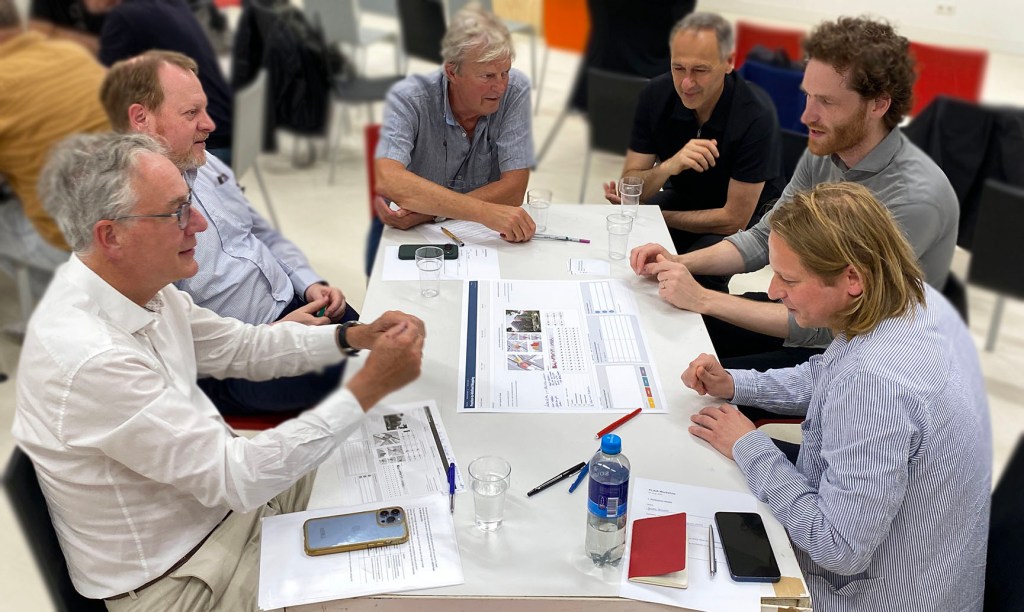
The key takeaway of a group discussion on Soft Values and AI for an urban design masterplan in Alphen aan den Rijn included reflections on how soft values like identity, well-being and socials encounters in a large-scale housing masterplan can be measured. Thoughts addresses the options of measuring them on a small scale and on a basic level. Some lines of thoughts in the group reflected on how the status-quo is not advanced enough to have an overall (digital) tool based on empirical evidence and literature, but that the first steps in exploring ways to include the theoretical framework into parametric design and AI-driven urban design can be made.
PLAIA is organizing several activities among researchers and stakeholders, to shape a common ground and roadmap. A workshop series of 3 workshops is a pillar activity during 2026. During Workshop 1 – Mapping & Alignment (3rd of June 2026) – we mapped current practice and AI-methods using real-life projects from architectural practices, discussed knowledge gaps, and identified the tensions worth working on together. The workshop included 2 Sessions, where the first one focused on practice-to-method mapping. In this session, mixed tables of five to six worked in parallel. Architects presented a recent completed project where soft values mattered, using printed visuals; researchers and AI/cognitive science experts proposed computational methods that could have supported it. Each table documented its process on an A2 poster and marked which input came from which profession. The output mapped how soft-value & AI-method pairings feed into the framework PLAIA outlines.
In this Session, one group focused on Soft Values and AI for urban design masterplans, such as a case study in Alphen aan den Rijn.
THE ALPHEN AAN DEN RIJN MASTERPLAN CASE STUDY. The case study was presented by GROOSMAN. Context. An urban design masterplan for a new district of approximately 1,000 dwellings in Alphen aan den Rijn. The ambition extends beyond meeting quantitative housing targets. The project explores how AI-driven and parametric design methods can be used to generate a plan in which soft values (for example identity, well-being, and the stimulation of encounter) are treated as leading design parameters rather than an afterthought layered onto a technically optimised masterplan. Soft values at stake. Identity and a recognisable sense of place for a newly built district without pre-existing character; the well-being of future residents across different life stages and household types; the stimulation of spontaneous encounter and social interaction in public and semi-public space; and a balance between privacy and social control in the transition between private, semi-public and public domains. Why these are challenging. New-built districts of this scale typically lack the layered history and slow-grown character that give older neighbourhoods their identity, making “identity” difficult to design for rather than discover. Soft values such as well-being and the possibility to encounter are inherently subjective and vary across residents, cultural backgrounds and life stages, resisting a single “average user” design solution. In a way it is possible to measure several parts of well-being, but the question rises if you measure the correct parameter. Masterplans are conventionally validated against financial and programmatic data, while soft values have no equivalent metric, making it hard to weigh them against hard performance criteria in a defensible way. Methods discussed. Translating soft values into measurable spatial parameters (e.g. façade-to-street ratio for human scale, walking distance to semi-public space for encounter, building setback for privacy). Building a generative/parametric model that produces a large number of plan variants based on these parameters, with financial feasibility included as a boundary condition (minimum feasibility is the base) rather than the leading principle; scoring variants through a composite Soft Values Index. The group discussed also validating variants with future residents, designers and (municipal) stakeholders through VR walkthroughs, combining quantitative data (gaze direction, movement patterns, dwell time, …) with qualitative feedback (interviews, semantic differential scales, …). AI and computation. AI and parametric design algorithms are used to rapidly generate and compare large numbers of masterplan variants against the soft-value parameters, functioning as an exploration and scoring engine rather than a decision-maker. The role of AI is to help architects with a new tool and to widen the design space between hard performance criteria (density, cost, technical norms) and soft values (identity, well-being, encounter). How this can technically be achieved remained to be addressed. Key takeaways. Soft values like identity, well-being and socials encounters in a large-scale housing masterplan can be measured on a small scale and on a basic level. The group concludes that the status-quo is not advanced enough to have an overall tool which is based on empirical evidence and literature but that the first steps in exploring ways to include the theoretical framework into parametric design and AI-driven urban design can be made.
These workshops are financed by ClickNL. The results of these workshops are part of the PLAIA project. Do you want to know more about the results? Would you like to participate in these workshops? You can contact Michela Turrin (project lead) and Antonia Sattler (main researcher) at TU Delft.


Leave a Reply