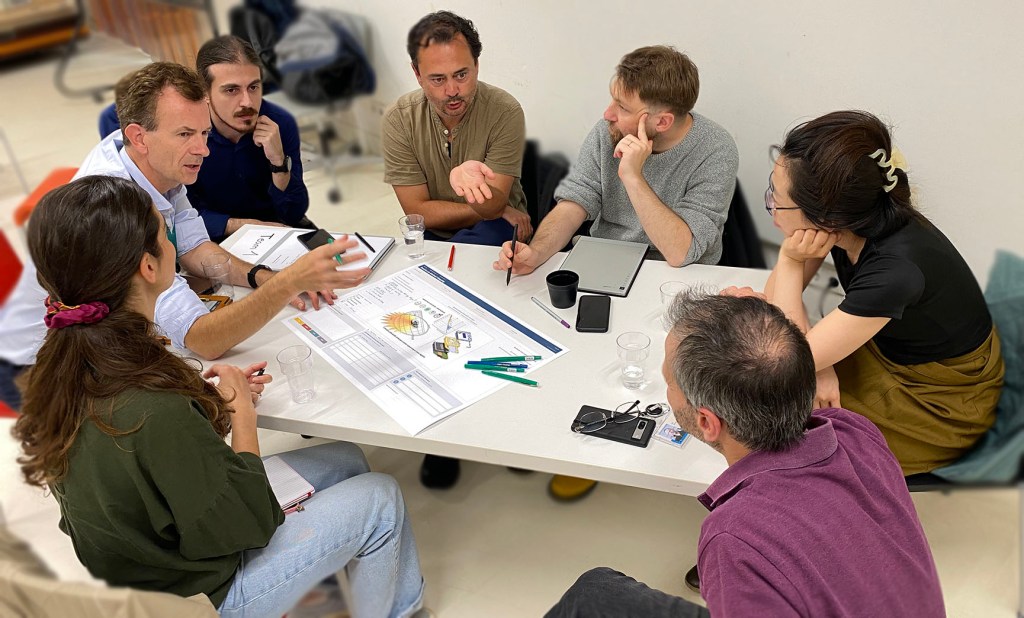
The key takeaway of a group discussion on Soft Values and AI for Educational Buildings pivoted around the role of AI in the design of these buildings. Reflections and questions included thoughts on how soft values are central to educational buildings but often under-articulated and under-valued in processes. Participants shared ideas on how integration requires awareness, explicit language, appropriate methods, and user/expert involvement. Several lines of thoughts addressed if and how AI’s ability to handle tacit, emotional, and aesthetic dimensions and highlighted this ability remains contested. Points of debate included also if and how the architect’s role is likely to evolve toward curating and guiding AI-generated options through a soft-value lens, rather than holding lower responsibilities.
PLAIA is organizing several activities among researchers and stakeholders, to shape a common ground and roadmap. A workshop series of 3 workshops is a pillar activity during 2026. During Workshop 1 – Mapping & Alignment (3rd of June 2026) – we mapped current practice and AI-methods using real-life projects from architectural practices, discussed knowledge gaps, and identified the tensions worth working on together. The workshop included 2 Sessions, where the first one focused on practice-to-method mapping. In this session, mixed tables of five to six worked in parallel. Architects presented a recent completed project where soft values mattered, using printed visuals; researchers and AI/cognitive science experts proposed computational methods that could have supported it. Each table documented its process on an A2 poster and marked which input came from which profession. The output mapped how soft-value & AI-method pairings feed into the framework PLAIA outlines.
In this Session, one group focused on Soft Values and AI for Educational Buildings by using a case study brought by the ArchiTech Company.
AN EDUCATIONAL BUILDING. The case study was presented by the ArchiTech Company. Context. The central question: How soft values – comfort, atmosphere, emotional attachment – can be integrated into the design of educational buildings, and what role AI might play. Scope: ensuring buildings are not only functionally and technically sound but also support well-being, learning, and a sense of belonging. Soft values at stake. In the design process: meaningful involvement of end users (students, teachers, stakeholders); the architect’s style and persona; and the beauty of the building (intuitive vs. partially quantifiable). For end users: comfort (thermal, acoustic, spatial), concentration, connection with nature, belonging and emotional attachment, and joy. Why these are challenging. Lack of awareness, as decision makers may treat soft values as secondary to cost and efficiency. Difficulty making them explicit, as stakeholders are rarely trained to articulate atmosphere, belonging, or joy. Complex multi-criteria optimization, as weighting cost vs. comfort vs. identity rests on subjective, contested assumptions. The Feyenoord stadium was discussed, where the maximally curved oval was chosen to preserve a sightline and the collective atmosphere (geometric decision driven by a soft value. Methods discussed. Expert input (architects, teachers, students); learning from precedents; agent-based simulation and quantification of use patterns and comfort; iterative feedback loops with real users, including XR to let users experience and co-create options; and gamification to surface preferences and emotional responses. AI and computation. AI’s main value was framed as expanding the design space – generating thousands of variants meeting technical criteria. The challenge is adding an emotional/soft-value filter layer to identify which options genuinely support comfort, belonging, and joy. No consensus on whether AI can elicit tacit architectural expertise or eventually replace the architect. Key takeaways. Soft values are central to educational buildings but often under-articulated and under-valued. Integration requires awareness, explicit language, appropriate methods, and user/expert involvement. AI’s ability to handle tacit, emotional, and aesthetic dimensions remains contested. The architect’s role is likely to evolve toward curating and guiding AI-generated options through a soft-value lens, rather than disappear.
These workshops are financed by ClickNL. The results of these workshops are part of the PLAIA project. Do you want to know more about the results? Would you like to participate in these workshops? You can contact Michela Turrin (project lead) and Antonia Sattler (main researcher) at TU Delft.


Leave a Reply