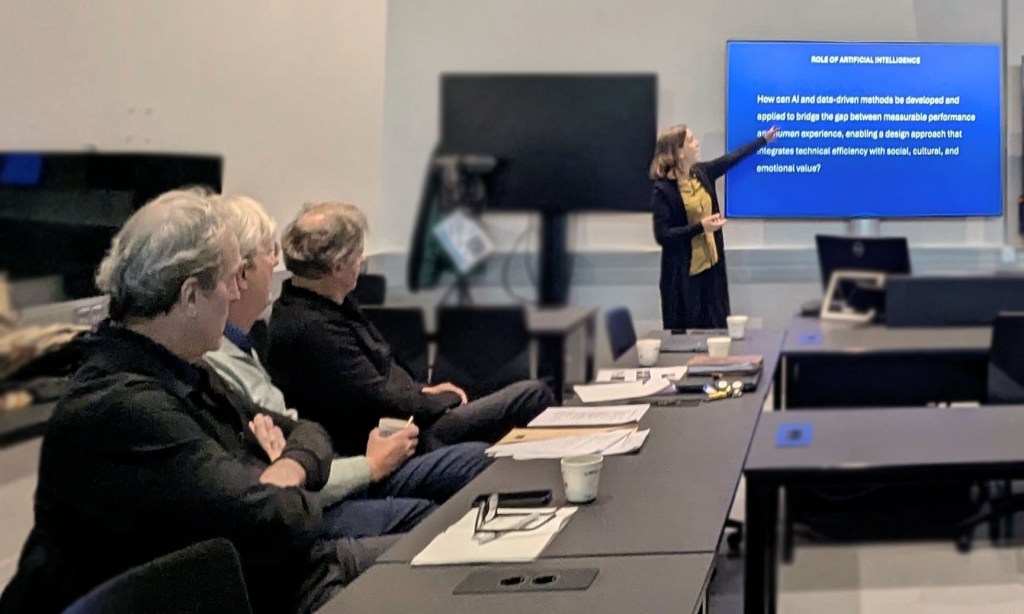
22 January 2026 – The workshop brought together researchers and practitioners to discuss the project trajectory in 2026. Over the year, the project will explore how artificial intelligence can support value-driven architectural design by integrating economic, technical (“hard”), and human-centered (“soft”) values.
The introductory session by Michela Turrin and Bart Mispelblom framed the discussion on whether these different categories of values complement each other or whether trade-offs and tensions emerge in design processes. Several reflections were shared on the overarching ambition of establishing an interdisciplinary knowledge platform that facilitates the exchange of ideas, methods, and data between academia and professional practice.
The discussions highlighted the importance of broadening the initiative beyond architecture and engineering by involving environmental psychologists, cognitive scientists, and eventually clients, developers, and building users. Participants emphasized that understanding and measuring human experiences and soft values – such as wellbeing, identity, atmosphere, and sense of place – requires expertise from multiple disciplines and may benefit from emerging technologies such as Virtual and Augmented Reality (VR/AR). Several reflections were shared on how these technologies can create immersive environments in which human experiences and perceptions can be observed and measured, generating new forms of data that can subsequently be used to train predictive AI models.
A major theme of the workshop concerned data: what data are needed, how they should be collected, and how they can be stored and shared responsibly. Participants discussed different models of data sharing, ranging from open-source approaches and anonymized datasets to metadata platforms and synthetic data generation. The Erasmus Centre for Data Analytics presented possibilities for collaborative data platforms that allow data sharing while respecting confidentiality constraints. Several participants agreed that the quality of AI applications fundamentally depends on the quality and relevance of the underlying datasets and that data collection should always be guided by clearly defined research questions and problem statements.
The discussions also highlighted the cyclical nature of design and data generation. Data can be collected throughout the entire building lifecycle – from requirements and design processes to building occupancy and user experiences – creating feedback loops that inform future projects and policies. Participants reflected on how such feedback mechanisms are particularly relevant for soft values and shared views on past experiences, especially related to on ongoing research on dementia care housing and user-centered building performance.
The workshop included a short session to draft a survey, which will be distributed among practitioners – focusing on the current use of AI in architectural practice and education. Participants discussed the need to map the maturity of AI adoption in architectural offices, distinguish between different types of AI use, and establish a shared vocabulary around concepts such as AI and soft values. Several reflections highlighted that survey should also investigate what types of data are currently being collected, including data from VR and AR applications, and how clients themselves are beginning to use AI in procurement and evaluation processes.
The final discussions centered on case studies and educational opportunities. Architectural practices expressed interest in collaborative case studies on topics such as social values in housing and user-centered design for dementia care. Participants emphasized the importance of contextualizing AI applications, integrating Building Information Modelling (BIM) with user experience data, and developing evaluation methodologies that are meaningful to both academia and practice. There was also interest in engaging students through internships, thesis projects, and collaborative research initiatives, thereby creating opportunities for knowledge transfer and capacity building.
[This post is a summary of the meeting’s minutes kindly noted by Feras Alsaggaf – summarized with the help of ChatGPT]


Leave a Reply