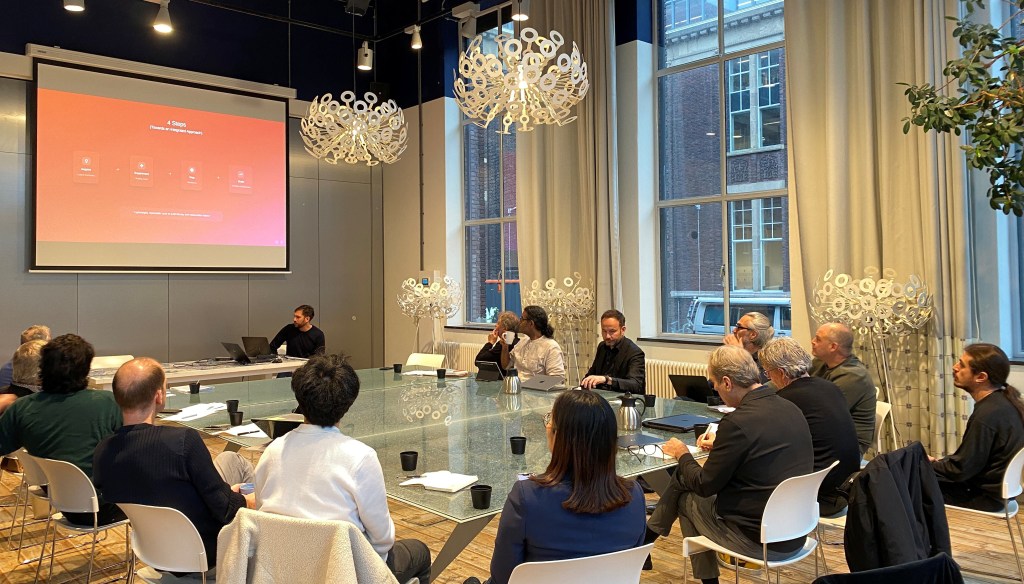
11 December 2025 – The discussion centered on the opportunities and challenges of integrating AI and soft values into architectural design practice. Participants questioned how intangible qualities such as atmosphere, identity, wellbeing, and sense of place can be represented, analyzed, and embedded within computational design processes, and how AI can support designers’ decision-making without replacing their creative and interpretative roles. This led to broader reflections on the need for interdisciplinary collaboration and data governance frameworks capable of combining architectural, social, cognitive, and ethical expertise. Particular attention was given to the development of methods that can align parametric optimization and performance-driven approaches with human-centered and ethical AI, enabling new forms of circular and value-driven innovation in the built environment and potentially leading to the creation of collaborative data spaces for architecture and practice.
A major theme of the discussion concerned openness and data sharing. Some participants argued that architectural data and methodologies should become fully open-source to accelerate innovation and improve design quality. Others expressed concerns that complete openness could diminish the competitive advantage of architectural practices, particularly in a profession where specialized knowledge often constitutes a key differentiator. This tension raised broader questions about the future role and value of architects in an increasingly data-driven and AI-supported profession. At the same time, a counterargument emerged: openness may ultimately strengthen the position of architects at the industry scale by enabling collaboration, increasing visibility, and creating new opportunities in relation to financial stakeholders and actors outside the traditional architectural domain.
Participants also emphasized the persistent gap between academic research and professional practice, noting that many research outputs remain confined to publications and struggle to translate into everyday workflows. This highlighted the need for a common language and shared conceptual frameworks that can facilitate communication between researchers and practitioners. Questions were raised about which values should be prioritized and optimized, how these priorities may evolve in the future, and whether current definitions of value will remain relevant. Finally, the discussion addressed the implications for architectural education, emphasizing opportunities to engage students and young professionals through internships, graduation projects, and initiatives such as thesis awards, thereby fostering a new generation of practitioners capable of working at the intersection of AI, data, and human-centered design.
The meeting was host at TU Delft, organized by Michela Turrin (TU Delft), Bart Mispelblom Beyer (TANGRAM), Eric van Heck (Erasmus Uni), Marcel van Oosterhout (Erasmus Uni), Guus Enning (former Coordinating Policy Advisor Education and Regulation, Atelier Rijksbouwmeester). The meeting welcomed several TU Delft and Erasmus Uni staff members with expertise in AI, Computational Design, and Economics – and several architectural and engineering firms, including for example Groosman and ArchiTech Company.
[The text of this post is a succinct summary of the meeting minutes – generated with the help of ChatGPT]


Leave a Reply